Complete Complaint Management System for Residential Communities
A must-have solution for large residential townships — staff housing, corporate housing, PSU colonies, army regiments, and temple trust residential units.
A Complaint Management System built for Large Residential Communities & Townships
Used by well-run residential communities where complaint volume, organisational hierarchy, and resident diversity demand a system built specifically for this context.
Trusted by leading institutions


Built for the specific reality of
large residential housing
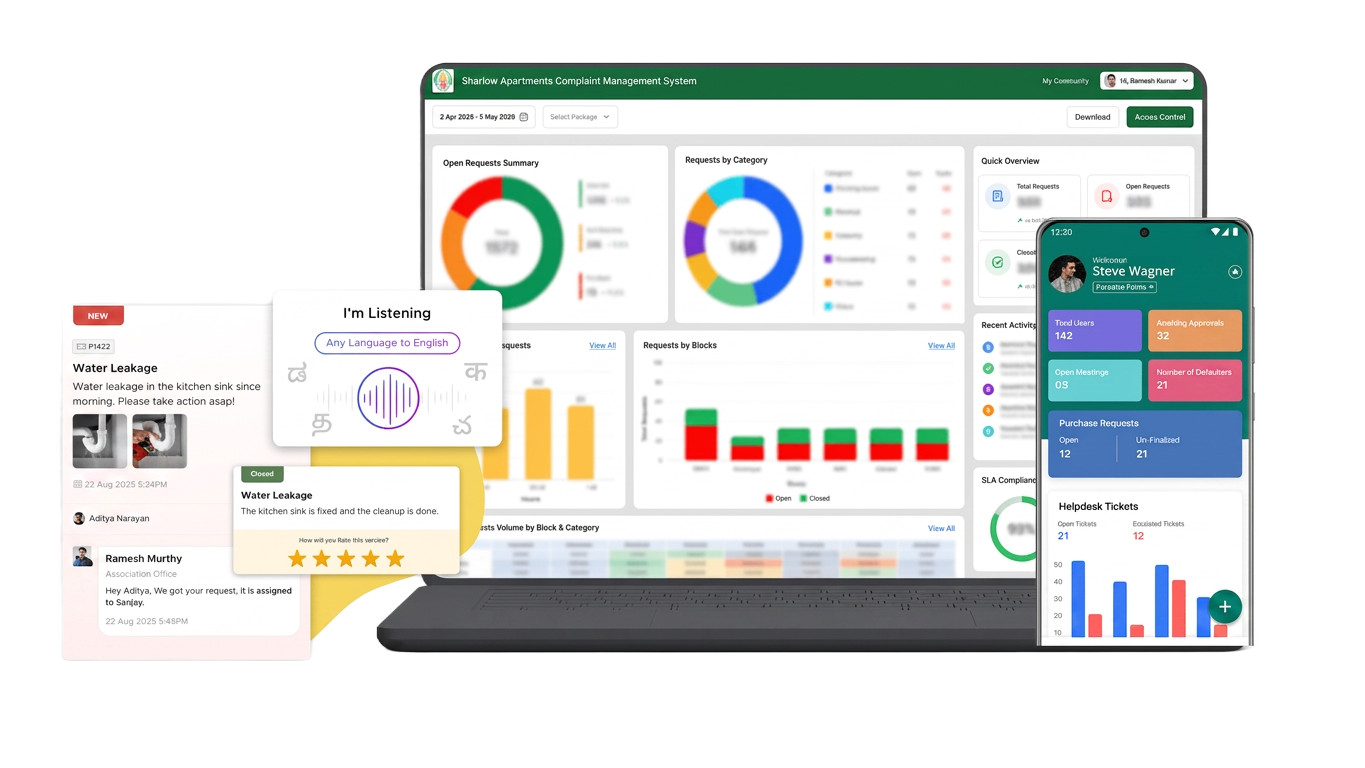
Configurable technicians, supervisors & escalations
Built to satisfy needs of large housing with option to set up separate technicians, supervisors and escalations for each buildings or cluster of buildings.
Quick Resolutions on the Go
Staff update tickets, upload photos, and close requests from the Community Manager App — directly from the site, in real time.
Robust Operational Controls
Two-way communication within tickets. Expense approvals in-app. Vendor access controls. Internal team notes. Everything needed to resolve complaints fast!
Simple yet powerful insights
Structured dashboards. No manual compilation. Insightful reports for everything — vendor reviews to management reporting.
Effortless Complaint Raising for every Resident
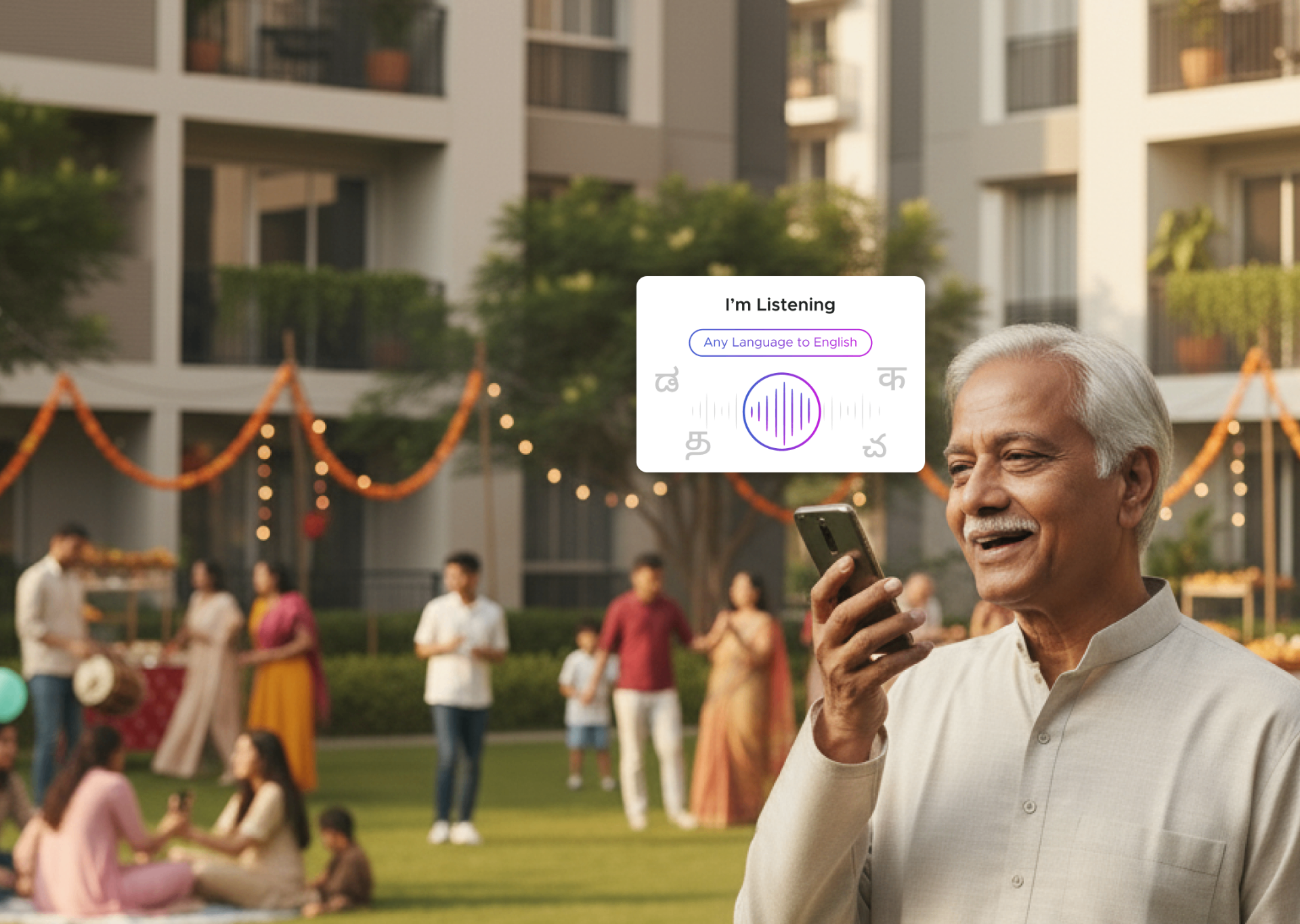
Ad Free App and ability to submit complaints by simply speaking in any language, makes the process super easy!
Most communities not using ADDA Desk have complaints disappearing into phone calls and WhatsApp messages, residents with no idea what's happening with their request, and management teams with no data to show for it.
ADDA Desk replaces all of that with one system — where every complaint is logged the moment it's raised, routed to the right person automatically, escalated if ignored, and closed with a record everyone can see. Residents stop calling the office to follow up. Management stops guessing what's open and what's overdue.
What is a complaint management system for a housing society?
A complaint management system for a housing society is a structured digital platform through which residents raise maintenance requests, service complaints, and queries — and through which the management team receives, assigns, tracks, and resolves those requests with complete accountability.
In a housing society or residential township, complaints cover a wide range — plumbing leaks, electrical faults, lift breakdowns, housekeeping issues, water supply failures, civil damage, common area maintenance, and more.
In most communities today, these complaints travel through phone calls to supervisors, messages in WhatsApp groups, entries in physical registers, and verbal follow-ups between shifts. The result is a predictable set of failures: complaints get lost, residents have no visibility, management has no data, and escalations happen inconsistently or not at all.
A purpose-built complaint management system replaces this with one structured workflow — every complaint is logged from the moment it is raised, automatically assigned to the right team, tracked through resolution, and closed with a verifiable record.
ADDA Desk is this system — built specifically for the scale and complexity of large residential communities, not adapted from a generic enterprise helpdesk tool.
Why housing societies need a dedicated complaint management system — not WhatsApp, and not an ad-supported app
Most housing societies today manage complaints through one of three systems: a phone complaint number with WhatsApp coordination, a paper register, or a community app that came bundled with a gate management product. None of these are complaint management systems. All three fail at scale for the same structural reasons.
The WhatsApp and phone complaint number model
Common in staff housing and PSU colonies
In institutional housing — PSU colonies, corporate staff townships, army residential units — the standard model is a dedicated complaint number that residents call, and a WhatsApp group through which the admin team coordinates resolution. This works at a very small scale. At the scale of a 500-unit or 2,000-unit township, it breaks down consistently.
A complaint call is received but not logged. The supervisor who took the call goes on leave. The next shift has no record. The resident calls again. They are told it is being looked at. Three days later, nothing has happened. The resident escalates to management directly — creating a dispute that should have been prevented by a system.
The structural failures are not about effort. They are about the tool.
A phone call cannot be automatically routed to the right team. A WhatsApp message cannot enforce a resolution deadline. A register cannot escalate a complaint to the next level of authority. And when a senior officer asks for a report, there is nothing to show — because the data never existed in a structured form.
The ad-supported community app model
Common in large gated communities
Large housing societies that adopted gate management apps over the last decade typically received a helpdesk module as part of their FREE ERP. On paper, the capability exists. In practice, it is largely unused — and the reason is structural.
These apps are funded by advertising. Their primary revenue comes from in-app promotions, sponsored notifications, and commercial content pushed to residents. The same notification channel that should carry a complaint status update — "your plumbing ticket has been assigned" — is also used to deliver advertisements for home loans, insurance, and local services. Residents cannot distinguish between a genuine community update and a sponsored message. Over weeks and months, they stop opening app notifications entirely.
On the ERP side, the same dynamic applies. Because the product's commercial model depends on advertising revenue rather than subscription revenue, investment in operational features — reporting dashboards, mobile tools for staff, block-wise routing, SLA enforcement — is consistently deprioritised.
The helpdesk exists but is feature-starved because the user is the product, not the facility manager.
What all three models share — and why ADDA Desk is different
Whether the current system is a phone line, a WhatsApp group, or an ad-supported app, the underlying problem is the same: the tool was not built for complaint management. It was built for something else — communication, gate access, advertising — and complaint management was added as a secondary function.
ADDA Desk is built for complaint management first, and only. It is funded by software subscription, not advertising — which means every product decision is made in service of the community, not in service of an ad platform.
- Resident notifications are trusted because they carry only community content.
- Staff have a full mobile app to resolve tickets from anywhere.
- Management has structured dashboards that answer real operational questions.
- Routing, escalation, and SLA enforcement are built into the architecture — not bolted on as afterthoughts.
ADDA Desk vs Ad-Supported Community ERPs
For large housing societies already on an ad-supported platform — where the helpdesk exists but residents cannot find it, staff have no mobile tools, and reporting is thin.
Finding the helpdesk in the app
Resident experience
Clean, ad-free app
Helpdesk is easy to find — no ads or promotional content cluttering the interface.
Buried under ads and spam
Residents can't easily find the helpdesk because the app is full of sponsored content masquerading as society notices.
Complaint update notifications
Do residents see them?
Noticed and read
Notifications are only for community updates — residents trust and open them.
Ignored alongside ad spam
Admin updates on tickets are mixed with promotional notifications — residents stop reading all of them.
Mobile app for helpdesk staff
Can staff resolve on the go?
Full Community Manager App
Staff update tickets, upload photos, and close requests from anywhere — no desktop needed.
Desktop-dependent
No robust mobile tool for helpdesk staff — they need to return to office to update tickets, slowing resolution by 50–70%.
Reporting and dashboards
Operational visibility for management
Structured, actionable reports
Category-wise volumes, SLA compliance, staff utilisation, resolution times — all built out and ready.
Feature-starved
Reporting is thin because product investment goes toward the ad platform, not operational tools.
L1 / L2 / L3 escalation by block
Routing for large communities
Configurable per category per block
Block C's plumbing routes to Block C's team — with automatic escalation when SLA is missed.
Flat, generic routing
No cluster-wise ownership — complaints land in a shared queue and get manually sorted.
Revenue model
Who funds the product?
Software subscription
Product investment goes into features — not into building an ad platform on top of your community.
Ad revenue
The ERP is a vehicle for advertising — operational features are secondary to ad inventory.
ADDA Desk vs Complaint Phone Line + WhatsApp Groups
For staff housing, PSU colonies, and institutional communities where residents call a complaint number and the admin team coordinates on WhatsApp.
Complaint logging
Is every complaint recorded?
Every complaint auto-logged
Ticket created the moment a complaint is raised — via app, QR code, or voice. Nothing falls through the cracks.
Only if someone writes it down
Phone calls go unrecorded unless staff manually log them. Missed calls mean missed complaints.
Routing to the right team
Does it reach the right person?
Automatic, by category and block
Complaints route directly to the correct technician or supervisor — no forwarding, no delays.
Manual forwarding on WhatsApp
Admin receives the call, messages the relevant person on WhatsApp, hopes they see it. Each handoff is a point of failure.
Resident visibility
Can residents track their complaint?
Real-time status in app or QR
Residents see when the ticket was received, who is working on it, and when it is resolved — without calling.
None — must call again to follow up
After filing a complaint, residents have no way to know what is happening. The only option is to call again.
Escalation when unresolved
What happens if no one acts?
Automatic — L1 to L2 to L3
SLA missed? The next level is automatically notified. No complaint sits unresolved because the right person was busy or on leave.
Depends on someone noticing
Escalation only happens if the admin manually follows up. If a WhatsApp message is missed, the complaint stalls indefinitely.
Audit trail
Is there a record when things go wrong?
Full record per ticket
Every action, communication, and resolution step is timestamped and stored. Available to management or senior officers on demand.
Scattered across individual phones
Complaint history lives in someone's call log or personal WhatsApp. When staff changes, the record disappears.
Management reporting
Can leadership see how the system is performing?
Structured dashboards — always ready
Complaint volumes by category, SLA compliance, resolution times — available without any manual compilation.
No data — only estimates
Management visibility depends entirely on what individual staff members report verbally. No data, no trends, no accountability.
What is
ADDA Desk?
ADDA Desk is a complaint and service request management system built specifically for residential communities — large ones, with hundreds or thousands of units, multiple blocks or towers, diverse maintenance categories, and resident populations that span multiple languages and levels of technology comfort.
It is not a general-purpose helpdesk tool repurposed for housing societies. It is built from the ground up for the specific operational reality of a residential township — where a water leakage in Block C needs to reach the plumber responsible for Block C specifically, not the one assigned to Block A; where a lift fault in Tower B needs to escalate to the right L2 owner if the L1 owner does not respond; where a resident in a PSU colony may prefer to raise a complaint by speaking in their native language; and where the management team needs to see, at any point, exactly how many complaints are open, which ones are overdue, and which categories are generating the most recurring issues.
ADDA Desk is used as a standalone product by communities that primarily need complaint management — without necessarily using the rest of ADDA's ERP modules. For these communities, ADDA Desk is the single operational tool that transforms how resident service requests are handled.
The complaint management system of choice across institutional and large-scale residential communities in India
PSU and private organisation staff housing
Public sector undertakings and large organisations maintain residential colonies adjacent to their facilities — refineries, power plants, steel plants, port authorities, and central government departments. Communities like GAIL, ONGC, and ITC's factory staff housing use ADDA Desk to manage service requests across large, multi-block campuses.
Temple trust and religious institution residential units
Large religious institutions manage substantial residential infrastructure — staff quarters and housing for trust employees. The Tirumala Tirupati Devasthanam is among the organisations that use ADDA Desk. Voice-based complaint raising and auto-translation features are particularly valuable here.
Army regiments, defence cantonments & armed forces units
Defence residential communities have a specific administrative structure with clear hierarchies. ADDA Desk's configurable L1, L2, L3 ownership maps directly onto these hierarchies. ADDA serves communities housing IAS, IPS officers, judiciary personnel, and active regiments of the armed forces.
Corporate townships and large gated communities
Large manufacturing companies and corporate campuses that maintain employee housing, and privately managed gated communities with 1,000+ units, use ADDA Desk where complaint volume demands structured routing and accountability.
The problem ADDA Desk solves
In most large residential townships today, complaint management runs on a combination of phone calls to supervisors, WhatsApp messages to shared groups, entries in physical registers, and verbal follow-ups. This creates predictable, recurring problems — not because the management team is not trying, but because the system structurally cannot deliver what residents need.
Complaints get lost.
A phone call to a supervisor who is on leave, a WhatsApp message in a group that is scrolled past, a register entry the next-shift supervisor does not see — complaints disappear with no record and no accountability.
Residents have no visibility.
Once a complaint is raised, the resident has no way to know what is happening with it. The only recourse is another phone call or WhatsApp message, which creates more noise without resolution.
Management has no data.
Without a structured system, the management team cannot see how many complaints are open, which categories generate the most volume, or what the average resolution time is. Decisions are made on instinct, not data.
Escalations are manual and inconsistent.
When a complaint is not resolved in time, escalating it requires someone to notice the delay, decide to escalate, find the right contact, and communicate the situation. This happens inconsistently.
There is no audit trail.
When a resident disputes a resolution or a senior officer asks for the history of a particular complaint, there is no record to show. Everything exists in individual phones and verbal memory.
ADDA Desk replaces all of this with one structured system where every complaint is logged, assigned, tracked, escalated automatically when needed, and resolved with a complete audit trail visible to everyone who needs it.
How residents raise complaints in ADDA Desk
Residents in large institutional housing are not a homogenous group. They range from smartphone-native professionals to senior employees who prefer to speak rather than type. The system accommodates all of them.
App-based complaint raising
Residents open the ad-free ADDA app, select category, describe the issue or attach a photo, and submit. The ticket is created instantly and routed to the correct team automatically.
QR code — no app needed
QR codes placed at common areas. Residents scan with any phone camera, fill a browser form — no download required — and submit. Same routing and escalation rules apply.
Voice AI — any language
Residents speak their complaint in any language. Voice AI transcribes and auto-translates for the admin team. Original voice note is preserved with the ticket.
How the admin system works
Category and block-wise ticket ownership
Configure separate L1, L2, and L3 owners for each combination of complaint category and block. A plumbing complaint from Block C goes to the plumber assigned to Block C — automatically.
L1, L2, L3 escalation hierarchy
Tickets escalate automatically when SLAs are missed — mirroring your community's administrative hierarchy. No manual chasing.
SLA configuration per category
Configure separate acknowledgement and resolution timelines for each complaint category. The system's expectations match operational reality.
Two-way communication within tickets
All communication happens within the ticket — resident, staff, admin, vendor. Nothing goes to WhatsApp. Nothing is communicated verbally and unrecorded.
Vendor & external contractor access
Role-based access — vendors see only their assigned tickets within their categories and blocks. Resident personal data stays protected.
Reports and analytics
Complaints by category, resolution time, SLA compliance, staff utilisation, pending complaints by age, and resident satisfaction — without manual compilation.
Everything needed to log, route, track and close every complaint
Configurable L1 / L2 / L3 ownership by category and block
Every complaint category has separate owners configured per block or cluster. Complaints route to the right person automatically.
- Separate ownership per category per block — any level of specificity
- Automatic routing on submission — no manual triage
- L1 → L2 → L3 escalation when SLA is missed
- Configuration updates instantly when staff changes
- Eliminates the most common failure: complaints reaching the wrong person
App, QR code, and voice — three ways to raise complaints
App for smartphone users. QR code for residents who won't download an app. Voice in any language for residents who prefer to speak.
- QR code works on any smartphone camera — no login, no download
- Voice input in any Indian language — auto-translated for admin
- No resident excluded due to technology or language constraints
- All three methods feed the same routing and escalation system
Automated SLA tracking and escalation
Configurable acknowledgement and resolution timelines per category. Automatic escalation when missed.
- Configurable SLA per complaint category
- Automatic L1 → L2 → L3 escalation on SLA breach — no manual monitoring
- Urgent tickets flagged for immediate attention
- Resolution time data feeds staff performance reporting
Role-based access for staff and vendors
Staff and contractors see only what is relevant to their role — by category, by block, by assignment.
- Category-wise and block-wise visibility control
- Vendors access only assigned tickets — no resident personal data visible
- Full admin visibility across all categories and blocks
Reports and dashboards for management oversight
Category-wise volumes, SLA compliance, resolution times, staff utilisation, and satisfaction ratings — structured and ready.
- Category and block-wise complaint volume reports
- SLA compliance and resolution time tracking
- Resident satisfaction ratings post-resolution
- Useful for vendor contract reviews and senior management reporting
What communities using only ADDA Desk get
ADDA Desk is available as a standalone product — no billing, accounting, or gate management modules required.
A single, structured channel replacing phone calls, WhatsApp groups, and paper registers
Complete transparency for residents — status visible without calling anyone
Clear accountability for management — every complaint assigned, every SLA miss escalated automatically
Operational data for senior management without manual compilation
A system that works for every resident — app, QR code, or voice in their native language
How ADDA Desk fits into the broader ADDA platform
For communities using ADDA Desk alongside communication, gate management, or facility modules — the helpdesk integrates naturally. Announcements reach residents through the same app they use to raise complaints. New residents added through move-in can raise tickets immediately. Asset records link to helpdesk tickets — creating a maintenance history.
For communities starting with ADDA Desk alone — the architecture is designed to expand. Adding modules later does not require migrating data or changing systems. The resident database built during ADDA Desk deployment powers every other ADDA module.
Frequently Asked Questions
Common questions from committees, facility managers, and admins evaluating ADDA Desk.
Built for the specific reality of large residential townships
PSU housing, corporate staff housing, army regiments, temple trust residential units, and large gated communities have specific complaint management requirements that generic helpdesk tools and ad-supported apps are not built for. ADDA Desk is.
Book a personalised demo to see how the system can be configured for your community's administrative structure, complaint categories, and resident profile.