

DPDP Act for Housing Societies in India
What Compliance Really Means — for RWAs, Residents, and Community Platforms
ADDA is Digital Personal Data Protection (DPDP) Act Certified
What This Means in Practice
ADDA.io got its DPDP Act Certificate on 10 Jan, 2026. At its core, this also means that ADDA's business model itself is aligned with the principles of the Digital Personal Data Protection Act and aligns to the law in Spirit. The platform does not rely on advertising, data monetisation, or any commercial use of resident data for revenue or growth.
This alignment is fundamental, because DPDP compliance cannot be sustained if a company's business interests are at odds with lawful, purpose-limited use of personal data.
In practical terms, this includes:
- No commercial or advertising-led use of resident data, ensuring there is no conflict between business incentives and data protection obligations.
- Clear, explicit consent mechanisms for any non-essential communication, presented transparently to every user of the app.
- Purpose-based data use by default, limited to core society governance such as billing, communication, security, and compliance.
- Easy and penalty-free opt-out options, allowing residents to withdraw consent for non-essential communication at any time without losing access to essential society services.
DPDP compliance at ADDA is not a one-time claim, but an ongoing commitment embedded into how the platform functions and how resident data is governed.
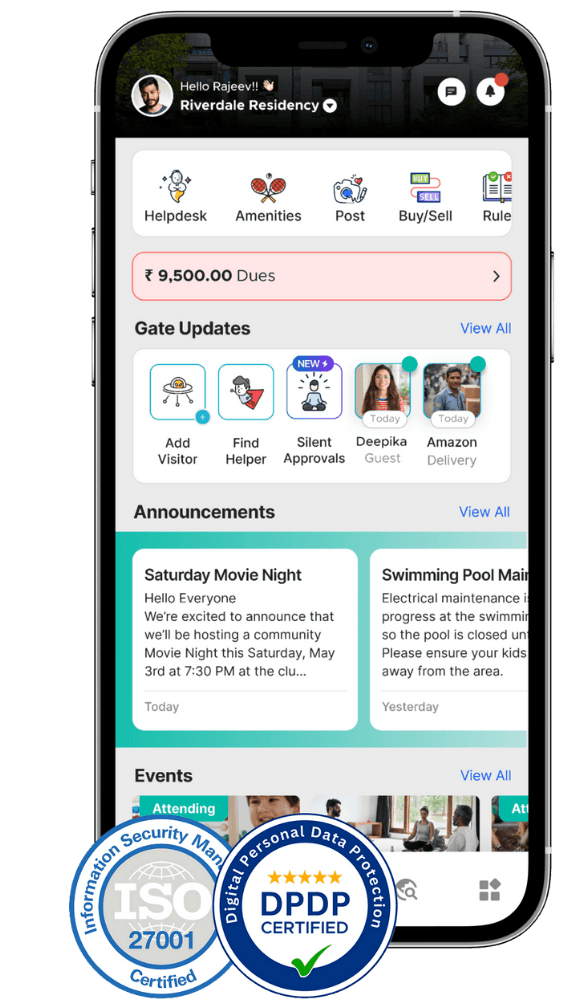
ADDA's Journey to DPDP Act Certification
A privacy-first philosophy has shaped how ADDA has been built over the last 16+ years. This approach was reinforced through work with residential communities in markets such as the UAE and the US, where data protection laws and expectations around personal data have long been more mature.
Even before the DPDP Act came into force in India, ADDA had implemented foundational principles such as purpose limitation, data minimisation, access control, and auditability. The DPDP Act brings formal structure and legal clarity to these principles in the Indian context, making this a welcome and timely development.
Why the DPDP Act Matters for Housing Societies
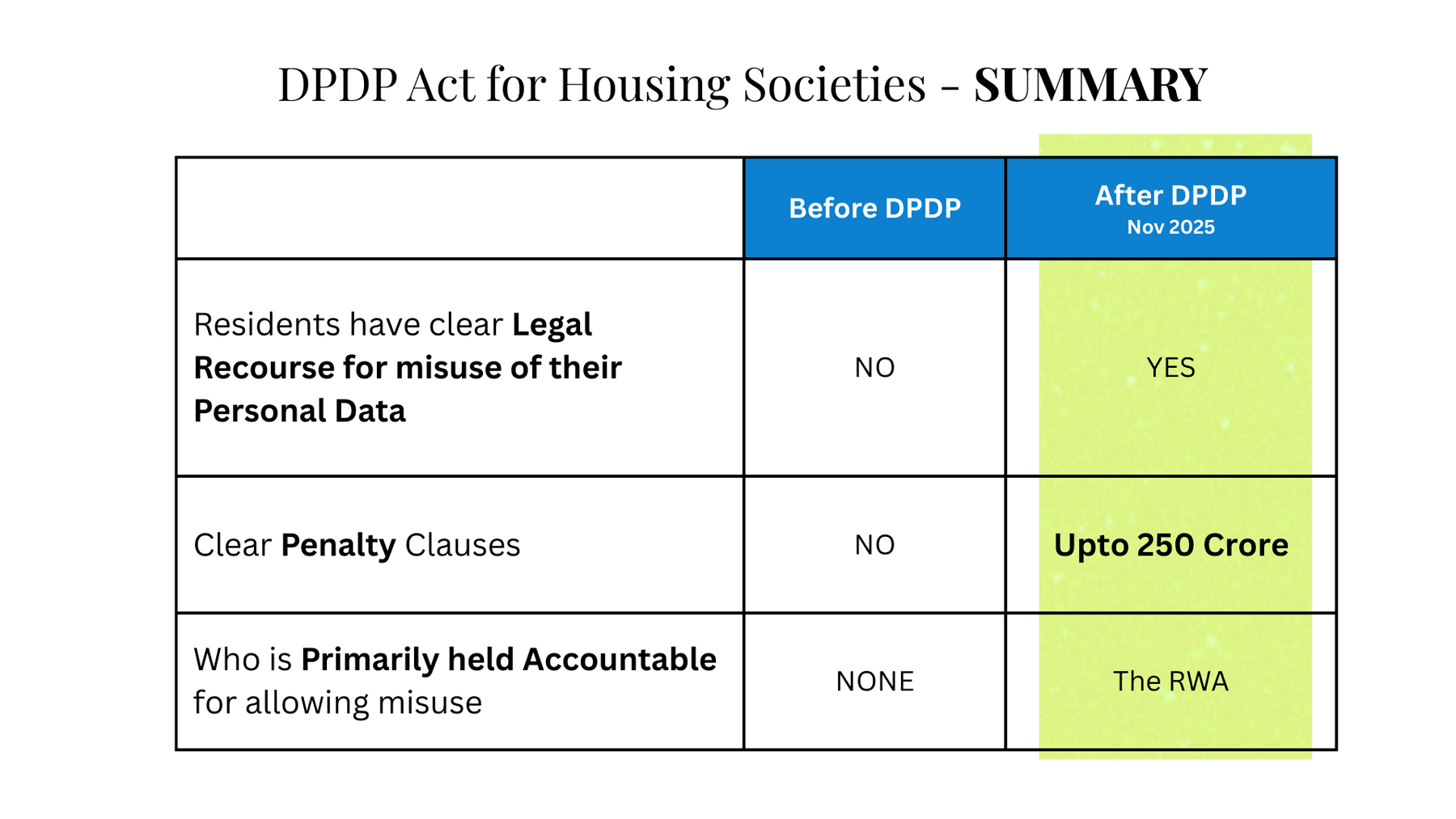
Housing societies are uniquely impacted by data protection laws. Residents routinely share highly sensitive personal information with RWAs and the technology platforms they use — not just names and phone numbers, but also home addresses, vehicle details, visitor records, billing information, and payment histories.
This data is closely tied to residents' homes and daily routines, making its protection especially critical. Until recently, the housing society ecosystem lacked a clearly defined, sector-specific regulatory framework governing such data use. The DPDP Act addresses this gap by formally bringing residential communities within India's data protection regime.
Roles Under the DPDP Act
The DPDP Act clearly defines roles in the context of housing societies:
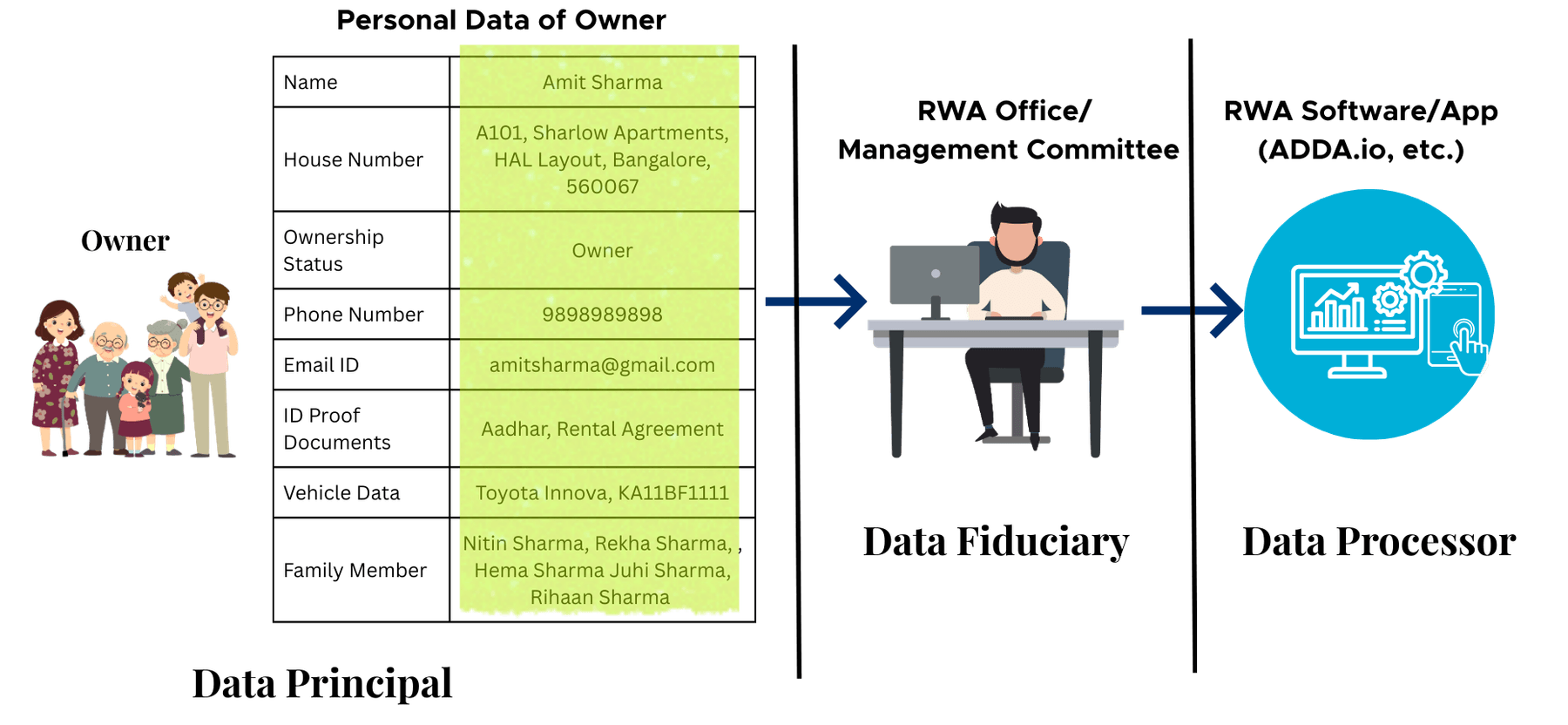
Data Principals
Residents / Owners / Tenants — the individuals to whom the data belongs
Data Fiduciaries
RWAs and Management Committees — responsible for deciding why and how resident data is used
Data Processors
Community Management Platforms — processing data strictly on the instructions of the RWA
Important: Accountability does not transfer completely to the software platform. Even when a platform processes resident data, the Management Committee remains legally responsible for ensuring lawful use, and for choosing the correct data processors.
Legitimate vs Non-Legitimate Use of Resident Data
Lawful & Legitimate (Primary) Use
Resident data may be used without additional consent for purposes essential to society governance, including:
- Official communication (AGMs, elections, statutory notices, emergencies)
- Maintenance billing, receipts, and accounting
- Online payments
- Complaint and service request workflows
- Amenity bookings
- Security, visitor and staff management
- Publishing official society documents
- Any use explicitly listed in the society's registered byelaws
Non-Essential or External Use
Any use beyond core society operations — such as advertisements, promotions, third-party offers, or unrelated analytics — requires explicit, informed, individual consent from residents.
Note: Blanket approvals or AGM resolutions do not qualify, and residents must be able to withdraw consent as easily as they give it.
Consent Manager in ADDA: What DPDP Requires
Under the DPDP Act, any use of resident data beyond essential society operations requires explicit consent. This consent must be a real choice, especially in housing societies where residents must use community apps for safety, communication, and governance and cannot simply opt out of the platform itself.
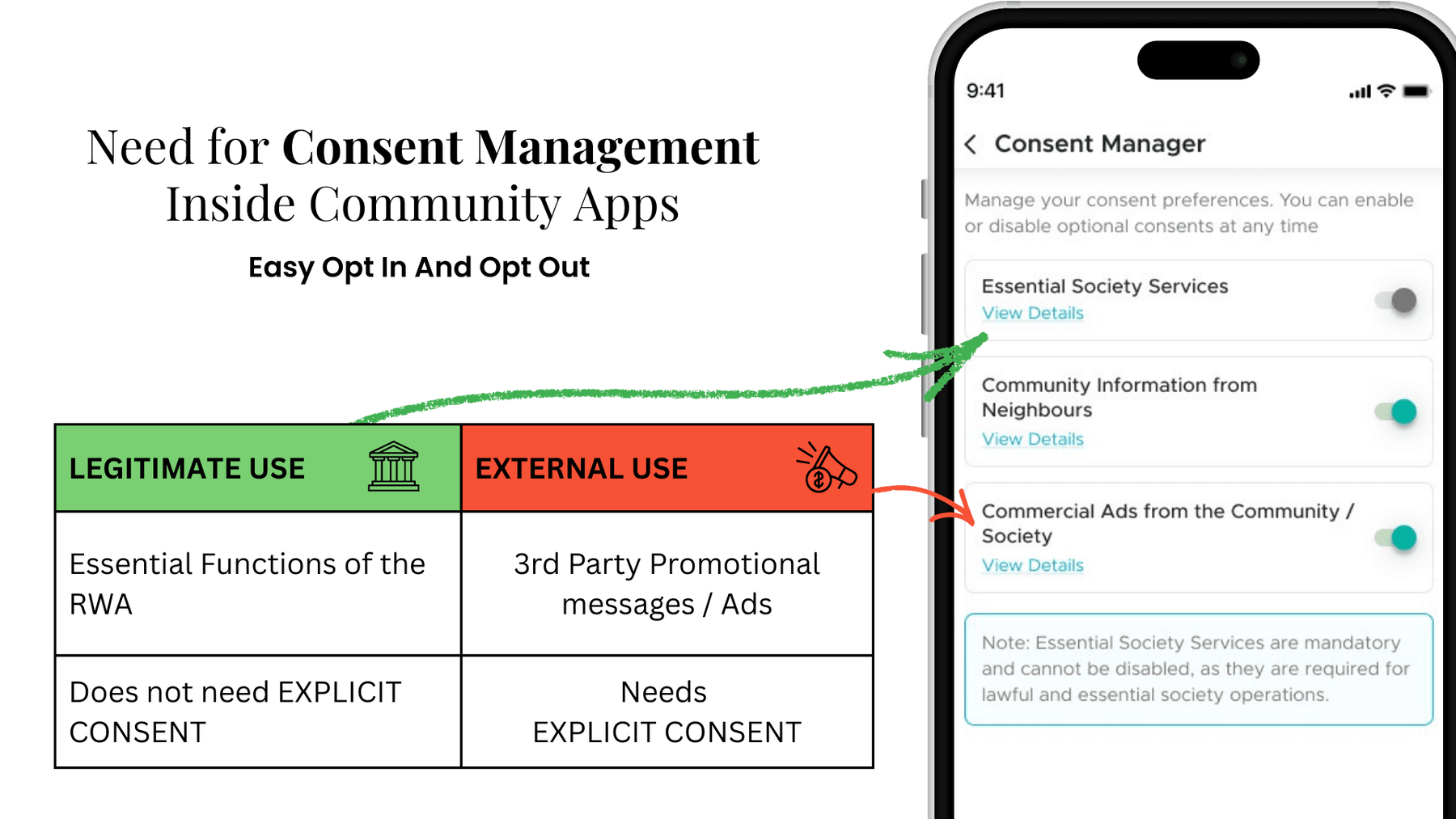
In practice, explicit consent means:
so data collected for society operations cannot be reused for promotions or advertisements by default.
allowing residents to access all core society features even if they choose not to receive promotions.
without additional charges or loss of access to essential services.
To support this, ADDA is implementing a dedicated consent manager that lets residents manage their consent preferences transparently while continuing to use all essential society features.
What "DPDP Compliant" Should Mean for Housing Societies
As DPDP enforcement begins, RWAs may encounter platforms claiming compliance or certification. To make sure that these are not just marketing labels, Management Committees should look for clear answers to questions such as:
Is the business model of the company based on just subscription or Advertisements?
It is better to stay away from businesses who has Ad business, as they would automatically have interest in your resident data for meeting their revenue goals.
Questions to Consider:
- Is clear, separate and informed consent taken separately for essential uses of the Housing society and non-essential uses like advertisements?
- Can residents login to the community app without having to give consent on non-essential uses like advertisements?
- Can residents easily withdraw consent without extra payment?
- Can the RWA independently access, export, or delete its data?
- Are audit logs and data access records available?
True DPDP compliance is reflected in processes, controls, and transparency — not just declarations.
How Responsibility Is Evaluated in Case of an Owner/Resident Complaint
If an owner/resident raises a complaint under the DPDP Act, authorities would usually evaluate responsibility based on the specific roles defined by the law — the Data Fiduciary (RWA) and the Data Processor (community platform).
The RWA / Management Committee is evaluated on whether:
- They exercised due diligence while selecting the technology platform, including assessing whether the platform's business model creates any conflict of interest around resident data.
- They avoided arrangements where resident data could be indirectly monetised, such as "free" or advertisement-driven software without adequate safeguards.
- They ensured that resident data was used only for lawful society purposes, or with explicit resident consent where required.
- They had clear contractual terms with the platform covering data use, security responsibilities, and accountability. That is they did not get into contracts where the vendor offered the RWA / Management Committee money for getting the contract.
The community platform (Data Processor) is evaluated on whether:
- It processed resident data strictly as instructed by the RWA, without using the data for any independent or undisclosed purpose.
- It implemented reasonable technical and organisational safeguards to protect resident data.
- It complied with applicable security and data protection guidelines issued under the DPDP Act.
Key Takeaway: Liability is determined based on whether each party acted responsibly within its role and took all reasonable steps to prevent misuse or data breaches.
Why Awareness Is the First Step to Compliance
The biggest risk for most housing societies today is not intent, but lack of awareness. DPDP compliance requires not only understanding responsibilities, reviewing existing practices, but also choosing the right technology platforms that align with the law's principles.
Frequently Asked Questions
The DPDP Act has moved into on-ground enforcement starting November 2025, with rules and enforcement mechanisms being rolled out in phases. Waiting for "full enforcement" is risky, because resident complaints can already trigger scrutiny. The Act encourages early compliance and corrective action, not reactive fixes after a dispute arises.
The DPDP Act has already been enacted into law, and its obligations apply in principle. However, enforcement is being rolled out in phases.
At present:
- The law itself is in force, and RWAs are expected to act in alignment with its principles, including purpose limitation, consent, and reasonable safeguards.
- Certain operational mechanisms, such as the full functioning of the Data Protection Board of India, are being notified and operationalised progressively.
- Once the Data Protection Board is fully constituted, residents will have a dedicated statutory forum to raise grievances under the DPDP Act.
Until then:
- Residents are not barred from raising complaints if they believe their digital personal data is being misused.
- Such complaints may be pursued through existing legal avenues, including civil courts or other applicable forums.
- Authorities are likely to examine whether the RWA and the platform acted in good faith and aligned with the spirit of the DPDP Act.
For RWAs, the key takeaway is that "waiting for full enforcement" is not a safe strategy. Early alignment and responsible data practices are strongly advisable.
This should be treated with caution. While the DPDP Act does not explicitly prohibit revenue-sharing or promotional arrangements, such models raise serious questions under the spirit of the law. If a software platform is offered at a reduced cost or for free, while simultaneously committing to generate revenue for the society through promotions or advertisements, it indicates that resident data or access to residents may be the underlying commercial consideration. As a Data Fiduciary, the RWA is expected to exercise due diligence and assess whether such arrangements create a conflict of interest or incentivise non-essential use of resident data.
Start with awareness. Review how resident data is currently used, classify uses as essential or non-essential, verify consent where required, and ensure that the chosen community platform aligns with DPDP principles and does not have conflicting business interests.
They can be. RWAs are expected to assess whether a platform's business model creates any conflict of interest around resident data. Using free or ad-driven platforms without understanding how resident data is monetised may be viewed as a lack of due diligence.
No. The DPDP Act states that withdrawal of consent must be as easy as giving consent. Charging residents to opt out of non-essential data use may expose the RWA to compliance risk.
Not by default. Any promotional, advertising, or third-party communication requires explicit, individual consent from residents. Blanket approvals or AGM resolutions do not qualify as valid consent under the Act.
No. Data required for essential society operations — such as billing, official communication, security, and compliance — can be used without separate consent. Explicit consent is required only for non-essential or external purposes, such as promotions or advertisements.
No. Even if a platform processes the data, the RWA remains accountable as the Data Fiduciary. Software providers act as Data Processors and cannot take legal responsibility on behalf of the RWA.